For years, my professional development followed a well-worn script: identify a trending skill, take a course, earn a certificate, and add a new line to my resume. I became proficient in specific software, methodologies, and platforms. Yet, I often felt a quiet anxiety—a sense that I was running on a treadmill, constantly updating just to stay in place.
The turning point came when a major industry shift rendered a set of my hard-won, narrow technical skills nearly obsolete almost overnight. It was then I realized I had been focusing on the wrong target. Today, my entire approach has shifted from chasing short-term skills to the deliberate, strategic building of capabilities.
This isn’t semantic gymnastics; it’s a fundamental mindset shift that has redefined my trajectory as a leader and the growth of my teams. In this article, I’ll explain what capabilities truly are, why they matter infinitely more than isolated skills in our volatile world, and provide a practical roadmap for how you can build them intentionally. This is about moving from being a temporary specialist to becoming a resilient, adaptable, and lasting asset.
What Does “Building Capabilities” Really Mean?
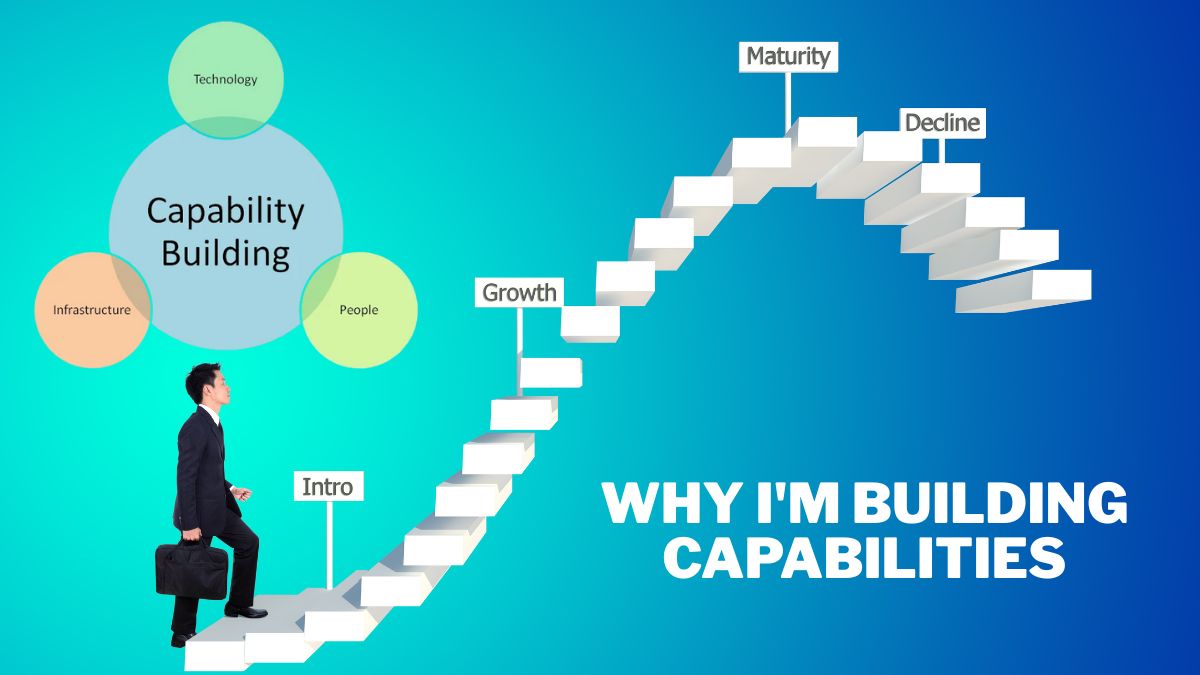
At its core, building capabilities means developing your inherent power and capacity to perform effectively across a range of unpredictable situations. Think of it not as adding another tool to your belt, but as fundamentally strengthening the arm that wields any tool. A capability is a dynamic combination of knowledge, skills, behaviors, and mindsets that enables you to create value and solve complex problems.
A skill is often a discrete, teachable activity: writing a line of code in Python, creating a pivot table, or operating a specific piece of machinery. A capability, in contrast, is how you apply a suite of skills, knowledge, and judgment. Problem-solving is a capability. It may draw on skills in data analysis, research, and technical writing, but it is defined by the higher-order ability to diagnose an ambiguous issue, synthesize information, and devise an effective solution.
Adaptability is a capability. It’s not a single skill but the cultivated capacity to learn, unlearn, and relearn in the face of change. Systems thinking is a capability—the mental model to see interconnections and long-term consequences, far beyond executing a single task. Building capabilities, therefore, is an investment in your foundational operating system, not just the apps you can run.
Skills vs Capabilities — What’s the Difference?
Understanding this distinction is critical for directing your energy wisely. Let’s break it down clearly.
Skills are task-based and short-term.
They are concrete, measurable, and often tied to a specific context or tool. They answer the question “How do you do this specific thing?” Examples include proficiency in Adobe Photoshop, mastering SEO keyword research, or knowing how to close a sale using a particular framework. While essential, skills have a diminishing half-life. They can become outdated, automated, or irrelevant as technology and markets evolve.
Capabilities are transferable and long-term.
They are holistic, integrative, and context-agnostic. They answer the question “How do you approach and navigate unknown situations?” Examples include critical thinking, ethical judgment, strategic influence, and learning agility. Capabilities don’t expire; they compound. Like a muscle, they grow stronger with use and become your portable toolkit for any professional challenge.
| Aspect | Skills | Capabilities |
|---|---|---|
| Nature | Task-specific, technical, procedural | Holistic, behavioral, cognitive |
| Timeframe | Short-term, often with an expiration date | Long-term, enduring, and compounding |
| Transferability | Low; often tied to a specific tool or role | High; applicable across roles and industries |
| Development | Through training, practice, instruction | Through experience, reflection, and challenge |
| Goal | To perform a defined activity effectively | To create value in uncertain, complex scenarios |
The key insight is that capabilities encompass skills. You use skills within a capability. For sustainable growth, you must focus on the broader capability, which will naturally guide you to acquire the necessary supporting skills along the way.
Why I’m Building Capabilities Instead of Chasing Trends
This is the heart of my shift. I am no longer distracted by the loud buzz of the “must-learn skill of the year.” My focus is on long-term capability building because the landscape demands it.
First, the pace of rapid technological change, especially AI and automation, is systematically eating away at narrow, repetitive skills. What cannot be easily automated is precisely the realm of capabilities: creative problem-finding, nuanced human communication, and ethical decision-making. I’m building what machines can’t replicate.
Second, adaptability is no longer a nice-to-have; it’s the price of admission. In a world where business models can be disrupted in months, the ability to pivot, learn quickly, and thrive in ambiguity is the ultimate career insurance. I invest in my learning agility so I am never left behind, regardless of what the “next big thing” turns out to be.
Finally, this is about resilience and longevity. A deep capability portfolio grants resilience in uncertain markets and career spans that may last 50 years. It allows me to move between functions and industries, lead through crises, and build businesses that withstand shocks. Chasing skills kept me employed for the next quarter. Building capabilities is my strategy for relevance for the next decade.
Capabilities That Matter Most Today
So, what should we be building? Based on my experience, these are the capabilities that matter most for professionals, founders, and leaders today:
- Critical Thinking & Problem-Framing: Beyond solving given problems, this is the ability to identify the right problem to solve—to question assumptions, analyze data without bias, and define the challenge accurately.
- Learning How to Learn: This meta-capability is the engine for all others. It’s the systematic process of acquiring new knowledge or skills efficiently, knowing which learning modality works for you, and being able to deconstruct complex topics.
- Decision-Making Under Uncertainty: The courage and analytical framework to make high-stakes calls with incomplete information, balancing data with intuition, and being accountable for outcomes.
- Communication and Influence: The capacity to articulate complex ideas with clarity, listen deeply, persuade diverse stakeholders, and build alignment without relying on formal authority.
- Systems Thinking: Seeing the whole board, not just the pieces. Understanding how decisions in one area (e.g., marketing, engineering, HR) create ripple effects throughout an entire organization or ecosystem.
- Leadership & Ownership: The mindset of stewardship over one’s domain, whether it’s a team, a project, or your own career. It’s about driving outcomes, developing others, and acting with accountability.
How I’m Actively Building These Capabilities
This isn’t theoretical. Personal capability development requires intentional, often uncomfortable, action. Here is my practical playbook:
- Learning Through Real, Stretch Projects: I deliberately seek or design projects that lie just outside my current competence. Theory is a starting point; capability is forged in the messy reality of application. Building a new team from scratch taught me more about leadership than any book.
- Systematic Reflection on Failures and Feedback: I maintain a simple reflection practice. After any significant project or decision, I ask: What worked? What didn’t? What did I learn about how I operate? More importantly, I actively seek and sit with uncomfortable feedback, as it’s the most direct signal for capability gaps.
- Pursuing Cross-Functional Work: I volunteer for initiatives that require me to work with departments I know little about. This forces me to develop communication, influence, and systems thinking as I navigate different languages, incentives, and perspectives.
- Creating Tight Feedback Loops: I don’t work in a vacuum. I share early drafts, propose half-baked ideas to trusted peers, and measure outcomes rigorously. This creates a cycle of build-measure-learn that accelerates capability development.
- Cultivating a Continuous Improvement Mindset: I view every task, no matter how small, as an opportunity to refine a capability. Can I communicate this email more clearly? Can I structure this meeting to drive better decisions? It’s the daily reps that build the muscle.
Why Capability Building Matters for Teams and Organizations
The logic of organizational capability building is a direct extension of the personal. As a leader, my goal is to build teams that are more than the sum of their individual skills.
A team with strong collective capabilities—like collaborative problem-solving, psychological safety for experimentation, and shared accountability—is antifragile. They solve problems faster because they aren’t waiting for a playbook; they create the playbook. They exhibit less dependency on any single tool, person, or outdated process. Ultimately, this is how you build a sustainable competitive advantage. Technology can be copied, strategies can be mimicked, but a deeply embedded culture of high organizational capability is exceptionally hard to replicate. It becomes the engine of enduring innovation and resilience.
Conclusion
My journey from skill-chaser to capability-builder has been the most profound professional shift I’ve made. It has replaced anxiety with agency and short-term tactics with a long-term strategy. Why am I building capabilities? Because it is the only path I see to meaningful, lasting growth in a world that is allergic to stagnation.
This is an invitation to rethink your own approach. Look beyond the next certificate or software update. Ask yourself what foundational capacities will allow you to thrive no matter what trend, technology, or disruption comes next. Invest in your operating system.
The compounding returns, in your career, your leadership, and your impact, will far outweigh any fleeting skill you might acquire today. The future belongs not to those who know how to do a specific thing, but to those who can figure out what needs to be done—and then lead the way in doing it.
FAQs About Why I’m Building Capabilities
What does building capabilities mean?
Building capabilities means developing your foundational capacity to perform and adapt in complex, changing environments. It goes beyond learning specific tasks (skills) to cultivate higher-order abilities like critical thinking, learning agility, and strategic influence that are transferable across roles and challenges.
Why are capabilities more important than skills?
While skills are essential for specific tasks, they have a shorter shelf life and can be automated. Capabilities are enduring, transferable, and compound over time. They enable you to learn new skills quickly, navigate uncertainty, and create value in ways that are difficult to outsource or automate, ensuring long-term relevance.
How long does it take to build capabilities?
Capability building is a continuous, lifelong process, not a one-time event. Unlike a skill that can be learned in weeks, a capability is developed and strengthened over years through deliberate practice, diverse experiences, and constant reflection. Significant growth can be seen in 6-18 months of focused effort.
Can capabilities be learned or only developed through experience?
Capabilities are primarily developed through applied experience and reflection. While their underlying concepts can be introduced through study or coaching, true mastery requires putting them into practice in real-world, often challenging, situations. Experience is the primary crucible for capability development.
Why are companies focusing on capability building?
Progressive companies understand that to innovate and stay competitive in a fast-changing world, they need resilient, adaptable, and creative workforces. Investing in organizational capability building creates teams that can solve novel problems, pivot strategies quickly, and maintain a competitive edge that is based on human ingenuity, not just static skill sets.
About the Author